From Hours to Minutes: Turning Long Events into Actionable Summaries with AI

Organizations today record more content than ever before: meetings, trainings, conferences, sermons, workshops and planning sessions. Almost every important moment is captured in audio or video.
However, there is a recurring pattern: people rarely have the time to go back and watch or listen to everything they have recorded. Valuable insights remain buried inside long files, and decisions are forgotten because no one converted the conversation into a structured record.
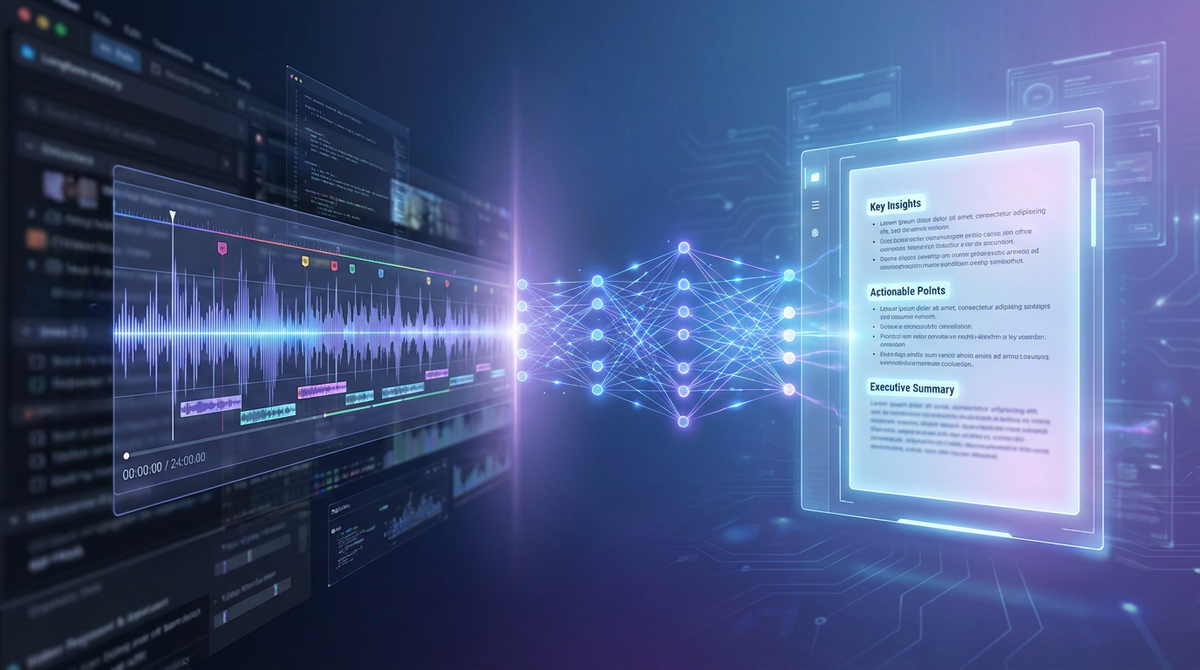
AI-powered summarization addresses exactly this gap: it transforms long, dense recordings into concise, usable documents that people actually read and act upon.
The Hidden Cost of Unprocessed Content
Recording a meeting or event gives a sense of security: “If we need it, it’s there.” But if no one ever revisits the recording, that security is largely symbolic.
Some of the hidden costs of unprocessed content include:
- Lost decisions: agreements made during a 90-minute meeting that no one writes down.
- Inconsistent communication: different people leave with different interpretations of what was decided.
- Time waste: if someone really needs to access that information later, they must spend an hour or more watching or listening.
- Missed opportunities: sermons, talks or trainings that could become articles, study guides or courses simply remain in raw form.
The result is a paradox: organizations invest time and effort to record everything, but they do not harvest the value of what they recorded.
A Typical Scenario: The Meeting That No One Has Time to Rewatch
Imagine a church or organization that holds a strategic planning meeting for the next six months. Pastors, leaders or managers gather for two hours to discuss priorities, schedules, responsibilities and new initiatives.
The entire session is recorded “so nothing is lost.”
The next day, everyone returns to their routine. E-mails, messages and other tasks accumulate. There is no time in the calendar to rewatch a two-hour meeting. Over time, some people remember the main decisions, others remember parts, and some details are simply lost.
Months later, the question appears: “Did we agree on this?” or “Who was responsible for that?” There is technically an answer in the recording, but practically, no one has the time to go back and search for it.
How AI Summarization Bridges the Gap
AI summarization changes the workflow from “we recorded it, but no one has time to rewatch” to “we recorded it, and now we have a structured summary we can use.”
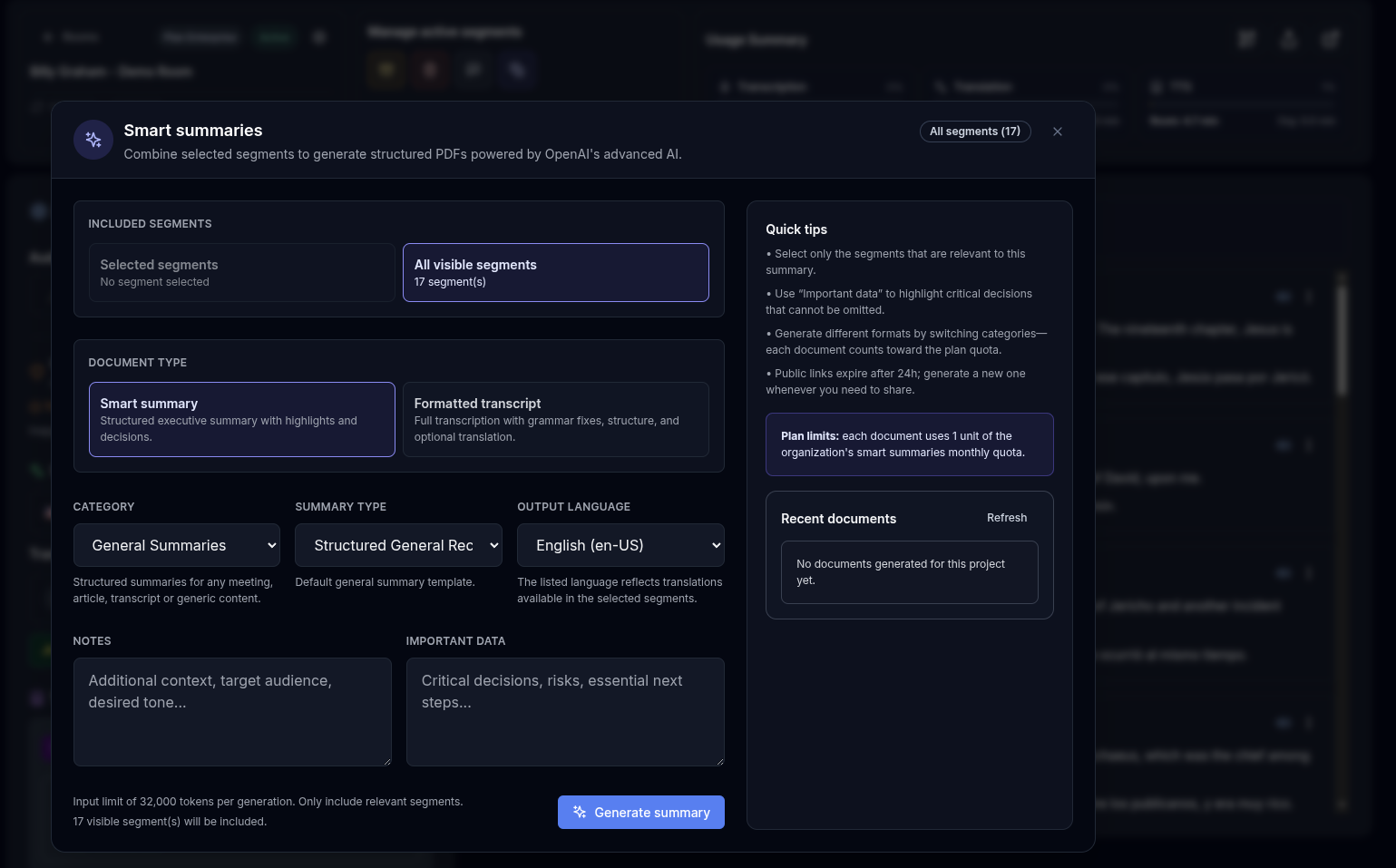
In platforms like TransVoicely, the process can follow a simple sequence:
- Record or upload the audio of the meeting, service or event.
- Transcribe the content with AI, turning speech into text.
- Select the relevant segments (if needed) or use the full session.
- Choose a summary template, such as:
- Board meeting summary,
- Service or sermon recap,
- Training session highlights,
- Ministry or project update.
- Generate a summary document in the desired language and format.
The result is a concise, structured document that captures decisions, key points, action items and relevant references — often in a matter of minutes.
Different Summary Types for Different Needs
Not every session has the same purpose. A flexible summarization system should be able to adapt to different contexts, for example:
- Operational meetings → focus on decisions, responsibilities and deadlines.
- Leadership retreats → capture strategic directions, principles and long-term goals.
- Sermons or teachings → provide a clear outline, main points, references and applications.
- Trainings and workshops → highlight practical steps, procedures and key learnings.
By using different templates and prompts, the same underlying technology can produce summaries that are tailored to the intended audience: leadership, members, staff, volunteers or external partners.
Saving Time for Leaders, Not Adding More Work
A critical aspect of any productivity tool is whether it genuinely saves time or merely adds another step to the workflow.
Well-designed summarization aims to reduce friction, not create it. For example:
- Leaders should not need to manually copy and paste large sections of text.
- They should be able to adjust only what is necessary: a title, a few key phrases, a nuance that the AI could not infer.
- The default experience should be: “I receive a draft that is 80–90% ready, and I only refine the remaining 10–20%.”
In this way, summarization supports leaders by providing them with material that is ready for sharing, archiving or teaching — instead of expecting them to start from a blank page every time.
Building an Accessible Knowledge Library
When summaries and structured documents are consistently produced from meetings, services and events, organizations gradually build a knowledge library.
This library can:
- document the evolution of decisions and strategies,
- keep track of what was shared in each series, course or campaign,
- provide reference material for new members, leaders or employees,
- support accountability and transparency for key initiatives.
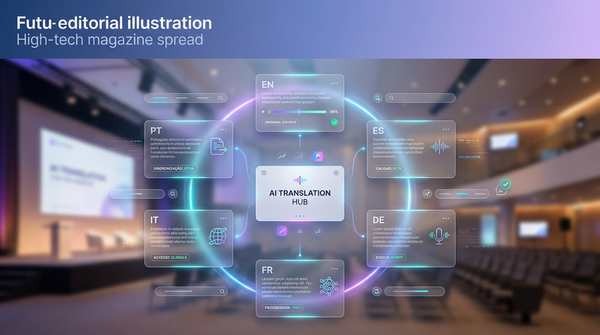
In a multilingual context, this becomes even more powerful: the same content can be summarized in one language and then translated into others, allowing different groups to access the material in a way that is meaningful to them.
A Practical Example: From Leadership Meeting to Actionable Summary
Consider the earlier scenario of a two-hour planning meeting. With AI summarization:
- The recording is transcribed automatically.
- A “Leadership Meeting Summary” template is applied.
- The AI generates a document that includes:
- Meeting date and participants,
- Main topics discussed,
- Decisions taken,
- Action items with assigned owners,
- Deadlines or target dates.
Instead of asking participants to rewatch the entire meeting, the organization distributes a two- or three-page summary that everyone can review in a few minutes. Questions are reduced, clarity increases, and the energy spent in the meeting produces concrete, visible outcomes.
Conclusion: Better Stewardship of What You Already Produce
Real-time transcription and recording capabilities are valuable, but their full potential is only realized when they are paired with tools that transform raw content into usable information.
AI-powered summarization helps organizations make better use of what they already produce. It honors the time invested in meetings, events and services by ensuring that key ideas do not vanish into unvisited files, but instead become accessible, shareable and actionable.
For churches, companies and institutions alike, this is not just a matter of convenience. It is a way to practice better stewardship of knowledge, decisions and message — turning hours into minutes without losing what matters most.